Safety doesn’t start with a policy—it starts with a conversation. Yet, many supervisors struggle to keep toolbox talks fresh, relevant, and compliant without spending hours preparing. The real pain? Running the same outdated safety chat week after week while risks evolve on-site. That’s where free toolbox talk topics come in: practical, accessible, and immediate tools to drive real behavioral change.
These talks aren’t just about checking a box. When done right, they reduce incidents, reinforce standards, and empower teams to speak up. But not all free topics are created equal. Generic PDFs with vague advice won’t cut it. The best ones are specific, actionable, and built for real-world conditions—like working at height with a new scaffold setup or handling a near-miss with a forklift.
Below is a curated list of high-impact, free toolbox talk topics, organized by risk category, with practical examples and implementation tips.
Why Free Toolbox Talk Topics Matter
Time is the most limited resource on any job site. Supervisors rarely have hours to draft safety briefings from scratch. That’s why free, well-structured topics are a game-changer. They offer:
- Immediate usability – Print and go, no rewriting needed
- Regulatory alignment – Many align with OSHA, ANSI, or local safety codes
- Consistency – Standardize messaging across crews and shifts
But beware: not all “free” content is reliable. Some sources recycle outdated or overly generic material—like a 5-minute talk on “general PPE use” that fails to address site-specific risks. The best free topics dive into real scenarios: muddy ladder conditions, communication gaps during crane lifts, or improper lockout-tagout in wet environments.
Look for content that includes discussion prompts, not just bullet points. A good topic should spark dialogue, not just deliver a lecture.
10 High-Impact Free Toolbox Talk Topics (With Use Cases)
These topics stand out because they’re specific, actionable, and widely available across reputable safety platforms.
1. Slips, Trips, and Falls on Wet Surfaces Use Case: A roofing crew in spring weather dealing with morning dew and icy patches. This talk covers common hazards like unmarked wet zones, improper footwear, and cluttered walkways. Include a visual checklist: “What three things can you fix in the next 10 minutes to reduce slip risk?”
Common Mistake: Assuming all crew members know what counts as a “slip hazard.” Many don’t recognize oil residue or uneven mats as risks.
2. Proper Use of Fall Protection at Height Use Case: Workers installing HVAC units on a commercial building’s roof. Go beyond “wear your harness.” Discuss anchor point inspection, lanyard length, and rescue planning. Emphasize: “If you fall, how long until someone notices? Who has the rescue kit?”
Tip: Pair this with a 5-minute gear check—have everyone inspect their harness D-rings and lanyard stitching.
3. Hand Tool Safety: Inspection and Handling Use Case: A maintenance team using hammers, wrenches, and pry bars daily. Focus on cracked handles, mushroomed chisels, and improper striking techniques. Example: “That sledgehammer with the loose head? It’s not just a tool—it’s a potential projectile.”
Action Step: Implement a “buddy check” system where workers inspect each other’s tools before shift start.

4. Hot Work and Fire Prevention Use Case: Welding near stored flammables in a fabrication shop. Highlight permit requirements, fire watch duties, and extinguisher placement. Include a real scenario: “Last month, a spark ignited cardboard 12 feet from the weld point. Could that happen here?”
Limitation: Many free talks skip post-work fire watch timing. Clarify: “Fire watch isn’t over when the torch is off—it lasts 30–60 minutes after.”
5. Electrical Safety Around Overhead Lines Use Case: Crane operators lifting near utility lines on a roadwork site. Stress minimum clearance distances (10 feet in most U.S. jurisdictions) and spotters’ roles. Use a visual: “If your load swings, does it stay clear?”
Critical Point: Workers often assume insulated gloves or tires offer protection. They don’t. Reinforce: “No rubber, no insulation, no second chances.”
6. Ladder Safety on Uneven Ground Use Case: Maintenance workers changing lights in a warehouse with sloped flooring. Cover ladder angle, securing the top and bottom, and three-point contact. Add: “That cinder block under the leg? It could shift. What’s a better solution?”
Workflow Tip: Keep ladder stabilizers or levelers in your safety kit—demonstrate their use during the talk.
7. Hazard Communication (HazCom) for Chemical Handling Use Case: Janitorial staff using degreasers and sanitizers. Break down GHS labels and SDS access. Ask: “If this cleaner spills, do you know where the spill kit is and how to use it?”
Mistake: Assuming everyone reads labels. Many workers skip them due to time pressure or language barriers. Advocate for visual aids.
8. PPE Fit and Limitations Use Case: New hires issued ill-fitting gloves and respirators. Discuss how loose gloves reduce grip, and improper respirator seals offer false security. Conduct a seal check live: “Cup your hands over the mask and inhale—feel any leaks?”
Key Insight: PPE is the last line of defense, not the first. Emphasize engineering and administrative controls first.
9. Back Safety and Proper Lifting Techniques Use Case: Warehouse workers moving 50-pound boxes daily. Go beyond “lift with your legs.” Address twisting, load size, and team lifts. Use a real example: “Two guys tried to lift a 120-pound motor alone. One pulled his back. What should they have done?”
Action: Practice the “power lift” stance as a group—feet shoulder-width, back straight, lift smoothly.
10. **Near-Miss Reporting and Why
It Matters* Use Case:* A worker almost trips over a cable but says nothing. Explain how near-misses predict future incidents. Share: “OSHA data shows 99% of falls have a near-miss first. If we don’t report them, we’re blind.”
Barrier: Fear of blame. Stress: “We want the hazard fixed, not the person punished.”
Where to Find Reliable Free Toolbox Talk Topics
Not all sources are equal. Stick to providers with real safety expertise—ideally OSHA-trained, industry-specific, or affiliated with safety councils.
Here are 5 trusted sources for genuinely useful free topics:
| Source | Strengths | Limitations |
|---|---|---|
| OSHA.gov | Official, compliant, no fluff | Less engaging, minimal discussion prompts |
| SafetyNow | Interactive formats, printable PDFs | Free section is limited; full access requires signup |
| Builder’s Safety Institute (Free Section) | Construction-focused, detailed | Some topics require paid membership |
| CDC/NIOSH | Evidence-based, health-focused | Less field-ready, more academic tone |
| Safeopedia | Broad topic range, user-submitted content | Quality varies—curate carefully |
Pro Tip: Download 3–5 topics from different sources, then customize them. Add your site’s photos, real near-miss stories, or local weather conditions to increase relevance.
How to Run an Effective Toolbox Talk (Without Wasting Time)
Even the best topic fails if delivered poorly. Follow this 5-step workflow:
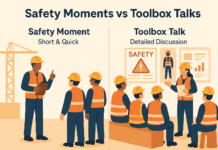
- Pick One Specific Hazard – Avoid “safety in general.” Focus on one task, tool, or condition.
- Limit to 10 Minutes – Eyes glaze after 12. Use a timer.
- Ask Questions – “Have you seen this happen?” “What would you do?”
- Include a Demonstration – Show, don’t tell. Use a harness, a ladder, a chemical label.
- Document It – Sign-in sheet, topic, date, attendees. Required for OSHA audits.
Avoid death-by-PowerPoint. These aren’t seminars—they’re field conversations. Hold them where the work happens: near the scaffold, by the breaker panel, next to the forklift.
Common Mistakes That Undermine Toolbox Talks
Even experienced supervisors slip into bad habits:
- Repeating the Same Topics – Talking about hard hats every week while ignoring new risks like drone use or battery charging stations. Rotate your topics monthly.
- Monologue Delivery – Standing with arms crossed, reading a sheet. That’s a lecture, not a talk. Sit in a circle. Make eye contact.
- Ignoring Feedback – If workers suggest a topic (“We need to talk about night shift lighting”), act on it. Their input builds ownership.
- Skipping Documentation – No record = no proof. Use a simple binder or digital log.
Making Free Topics Work for Your Team
Free doesn’t mean “ready to deploy as-is.” Customize every talk:
- Replace generic images with photos from your site
- Add your company’s incident history (anonymized)
- Translate key points if needed
- Include local weather impacts (e.g., “In high winds, how does that affect your scaffold?”)
For example, a free topic on heat stress might say “stay hydrated.” But on your site, add: “Our water station is behind the trailer—no excuses. It’s stocked every morning at 5 a.m.”
Final Thoughts: Safety Starts with the Right Conversation
Free toolbox talk topics are more than compliance tools—they’re opportunities to build a culture where safety is visible, spoken, and lived. The best ones don’t just inform; they involve. They turn passive listeners into active participants who spot risks before they turn into incidents.
Don’t wait for an audit or a near-miss to improve your talks. Pick one of the topics above, customize it for your crew, and run it tomorrow morning. Keep it short, real, and focused. That’s how safety sticks.
FAQ
Where can I download free toolbox talk topics? Reputable sources include OSHA.gov, SafetyNow, Safeopedia, and the Builder’s Safety Institute. Always verify content aligns with your industry and region.
Are free toolbox talks OSHA-compliant? They can be, but only if they cover required topics (like hazard communication or fall protection) and are properly documented with attendance records.
How often should toolbox talks be held? Weekly is ideal for high-risk environments like construction. Monthly may suffice for low-risk offices, but adjust based on incidents, new equipment, or seasonal hazards.
Can I customize free toolbox talk topics? Absolutely. In fact, you should. Add site-specific examples, photos, and your safety policies to increase relevance and engagement.
What should a toolbox talk include? A clear topic, 3–5 key points, discussion questions, a demonstration (if possible), and a sign-in sheet for documentation.
How long should a toolbox talk last? Aim for 5–10 minutes. Longer sessions lose attention. Focus on one actionable takeaway.
Do I need to train supervisors to deliver toolbox talks? Yes. Even with free topics, delivery matters. Train leads on facilitation, not just reading—how to ask questions, read the room, and encourage participation.
FAQ
What should you look for in Top Free Toolbox Talk Topics for Safer Workplaces? Focus on relevance, practical value, and how well the solution matches real user intent.
Is Top Free Toolbox Talk Topics for Safer Workplaces suitable for beginners? That depends on the workflow, but a clear step-by-step approach usually makes it easier to start.
How do you compare options around Top Free Toolbox Talk Topics for Safer Workplaces? Compare features, trust signals, limitations, pricing, and ease of implementation.
What mistakes should you avoid? Avoid generic choices, weak validation, and decisions based only on marketing claims.
What is the next best step? Shortlist the most relevant options, validate them quickly, and refine from real-world results.